
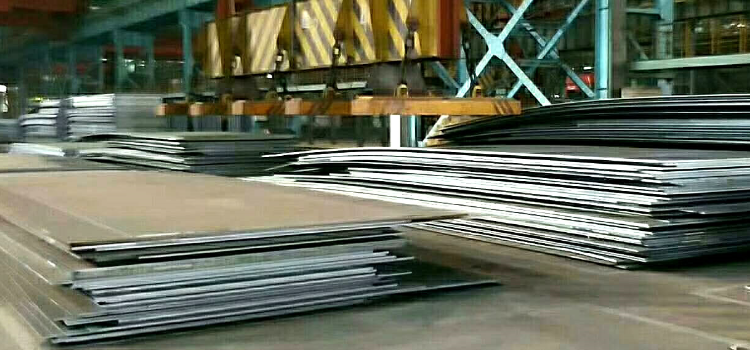
Gangsteel supplies DIN 17100 ST52-3 steel plate, including orders specifying ST52-3N, for load-bearing steelwork and engineered fabrications. For projects retaining this legacy designation, we review the standard edition, delivery condition, plate dimensions and inspection requirements before confirming production and export supply. This page covers both names within our DIN 17100 steel plate family.
St52-3 is a general structural steel with a minimum upper yield point of 355 MPa at thickness up to 16 mm; the minimum reduces as thickness increases. In the January 1980 edition, St52-3 plate has a normalized or equivalent normalizing-rolled delivery basis. The appended N in St52-3N makes the normalized condition explicit: it does not create a separate chemical-composition grade. DIN 17100 is withdrawn, so a legacy order and a proposed modern replacement must be reviewed against their respective specifications rather than matched by name alone.
Grade Designation
- DIN 17100 — the former German quality standard for steels for general structural purposes; the numerical data below use the January 1980 edition.
- St52-3 — the base steel designation listed in Tables 1 and 2, with quality group 3 requirements.
- ST52-3N — the commonly written form with N identifying normalized delivery. The actual delivery route must be stated in the order and inspection document.
- Material number 1.0570 — the number listed for St52-3 in Table 1 of this edition.
DIN 17100 ST52-3, St52-3, St 52-3 and DIN17100 ST52-3 are familiar written forms of the legacy designation. St52-3N and St 52-3 N identify the condition more explicitly. Neither the number 52 nor the suffix N replaces the thickness-dependent mechanical requirements.
Key Advantages of ST52-3 and ST52-3N Steel Plate
- Defined yield and tensile requirements for structural design, with separate thickness bands rather than a single strength claim.
- Special-killed steelmaking and nitrogen-binding provisions for the quality group 3 grade.
- A normalized delivery basis for plate, with an equivalent condition obtained by normalizing rolling permitted by the standard.
- Specified longitudinal impact requirements for the normalized condition, subject to thickness and specimen rules.
- A clear purchasing route for legacy drawings: agree the grade, condition, testing and documentation before production rather than relying on a commercial equivalence label.
Chemical Composition (Heat Analysis, Maximum %)
| Element / thickness basis | St52-3 heat analysis, mass % | ST52-3N heat analysis, mass % |
|---|---|---|
| C, thickness ≤30 mm | 0.20 max | 0.20 max |
| C, thickness >30–100 mm | 0.22 max | 0.22 max |
| C, thickness >100 mm | By agreement | By agreement |
| Si | 0.55 max | 0.55 max |
| Mn | 1.60 max | 1.60 max |
| P | 0.040 max | 0.040 max |
| S | 0.040 max | 0.040 max |
These ladle-analysis limits come from DIN 17100:1980-01, Table 1 and its footnotes, for the base St52-3 plate grade. The N condition suffix does not change this chemistry table. The special-purpose KSt52-3 and RoSt52-3 variants have separate carbon footnotes and are not the products described here. Table 1 specifies special-killed deoxidation, coded RR, and additional nitrogen-binding elements; a dash in its nitrogen column is not a zero-nitrogen requirement. Product-analysis limits are separate and must not be substituted for heat-analysis limits.
Mechanical Properties
| Nominal plate thickness | Upper yield point ReH min, MPa | Tensile strength Rm, MPa |
|---|---|---|
| <3 mm | 355 | 510–680 |
| 3–16 mm | 355 | 490–630 |
| >16–40 mm | 345 | 490–630 |
| >40–63 mm | 335 | 490–630 |
| >63–80 mm | 325 | 490–630 |
| >80–100 mm | 315 | 490–630 |
| >100 mm | By agreement | By agreement |
Table 2 gives these tensile-test requirements for St52-3; the N suffix does not introduce a second strength table. For flat products of width ≥600 mm, tensile specimens are transverse to rolling; the table otherwise specifies longitudinal specimens. Confirm the ordered thickness, specimen orientation, delivery condition and acceptance values on the mill certificate / inspection document. Values above 100 mm require agreement and must not be extrapolated from the thinner bands.
| Nominal thickness | Minimum transverse elongation, % | Gauge-length basis |
|---|---|---|
| 3–40 mm | 20 | L₀ = 5d₀ |
| >40–63 mm | 19 | L₀ = 5d₀ |
| >63–100 mm | 18 | L₀ = 5d₀ |
These are the transverse values in Table 2 for the proportional-specimen thickness bands shown, appropriate to flat products of width ≥600 mm. Thin-product fixed-gauge-length elongation requirements and longitudinal values are different; do not apply this abbreviated elongation table outside its stated scope.
| Condition and test | Nominal product thickness | Minimum average energy |
|---|---|---|
| Normalized N; longitudinal ISO V-notch, −20 °C | 10–63 mm | 27 J |
| Normalized N; longitudinal ISO V-notch, −20 °C | >63–100 mm | 23 J |
| Normalized N; longitudinal ISO V-notch, −20 °C | >100 mm | By agreement |
The impact entries are from Table 2 for the normalized N condition, relevant to ST52-3N plate. They are not an unconditional toughness claim for material delivered untreated. Results are the average of three tests; only one result may fall below the specified average minimum, by no more than 30%. Specimens narrower than 10 mm require the separate rules of Clause 8.4.1.4 and Figure 1, not automatic use of the full-size energies above. A −20 °C impact test does not by itself establish an allowable service temperature.
ST52-3 and ST52-3N: Delivery Condition Compared
| Order wording | What it establishes | What still needs confirmation |
|---|---|---|
| DIN 17100 St52-3 plate | Base grade and quality group; Table 4 gives N as the usual plate delivery condition | Edition, actual delivery route, dimensions, testing and inspection document |
| DIN 17100 St52-3N plate | The same base grade with normalized condition explicitly identified | Actual heat treatment or permitted equivalent rolling route and the ordered acceptance requirements |
Clause 8.2 and Table 4 distinguish the usual delivery conditions by product form, grade and thickness. For St52-3 plate, N is the usual condition across the table’s thickness divisions; normalizing can be replaced by controlled temperature during and after rolling. Do not describe every unsuffixed ST52-3 plate as as-rolled, or treat N as a higher-strength alloy. If the contract requires furnace normalizing specifically, state that requirement and obtain mill confirmation.
Fabrication must be planned for the actual heat chemistry, thickness, joint restraint and applicable design code. The grade name alone does not establish a welding procedure, preheat temperature, consumable or post-weld heat-treatment schedule. Any subsequent forming or heat treatment must preserve the ordered properties.
Available Dimensions
Send the required thickness × width × length and quantity for a project-specific quotation. DIN 17100 is a material quality standard, not a current stock catalogue: nominal dimensions and dimensional tolerances must be agreed using the applicable dimensional standard. The thickness bands above describe property requirements, not a promise of stock availability.
- Confirm mill capability and availability for the exact St52-3 or ST52-3N plate dimensions.
- For thickness above 100 mm, agree chemistry and mechanical requirements explicitly before ordering.
- Include dimensional tolerances, delivery condition, testing, inspection documentation and any cutting or processing drawings in the enquiry.
Main Applications
- Load-bearing building steelwork and fabricated support structures.
- Bridge components and structural connection plates where the design retains this legacy specification.
- Machinery frames, vehicle structures and general engineered fabrications.
DIN 17100 covers general structural steel used in welded, riveted and bolted components. Suitability for an individual structure depends on the designer’s assessment of strength, toughness, temperature, fatigue, thickness and fabrication. ST52-3N is not automatically a pressure-vessel material or an approved substitute for a dedicated pressure-equipment specification.
Equivalent Grades of DIN 17100 ST52-3 and ST52-3N
DIN 17100 is withdrawn. Its structural-steel provisions were superseded by the EN 10025 family, including the non-alloy structural-steel specifications now associated with EN 10025-2. For a new project, review the current specification rather than copying a withdrawn DIN designation without qualification.
No drop-in cross-standard equivalent is asserted here for DIN 17100 ST52-3 or ST52-3N. A proposed EN 10025-2 replacement must be selected with the purchaser and designer after comparing chemistry, thickness-dependent yield and tensile strength, impact quality, delivery condition and the applicable construction code. Matching a nominal strength class or a material-number reference does not establish full equivalence.
EN 10025-3 S355N and EN 10025-3 S355NL are separate normalized fine-grain structural grades worth reviewing when a project calls for that specification. They are not alternate spellings of St52-3N and must not be substituted on the strength of the shared letter N.
Related Products
- DIN 17100 steel plates — family page
- Low-alloy and high-strength steel plate
- EN 10025-2 steel plate
- EN 10025-3 steel plate
- EN 10025-3 S355N steel plate
- EN 10025-3 S355NL steel plate
Frequently Asked Questions (FAQ)
What is DIN 17100 ST52-3 (St52-3) steel plate?
DIN 17100 ST52-3 is a legacy general structural steel grade listed with material number 1.0570 in the January 1980 edition. Its upper yield point minimum starts at 355 MPa for thickness up to 16 mm and decreases in thicker product bands.
What does the N mean in DIN 17100 ST52-3N?
The N in DIN 17100 ST52-3N identifies normalized delivery. It is a condition suffix, not a different chemistry grade. The standard permits an equivalent condition obtained through controlled rolling temperature; confirm the actual route, especially if the order specifically requires furnace normalizing.
Is unsuffixed DIN 17100 ST52-3 always supplied as-rolled?
No. For DIN 17100 ST52-3 plate, Table 4 of the 1980 edition gives N as the usual delivery condition. An unsuffixed grade name alone is not evidence of untreated delivery; read the order and inspection document together.
Does DIN 17100 ST52-3 have the same strength at every thickness?
No. DIN 17100 ST52-3 has a yield minimum of 355 MPa up to 16 mm, falling to 315 MPa above 80–100 mm. The tensile range is 510–680 MPa below 3 mm and 490–630 MPa from 3–100 mm. Above 100 mm, the tabulated strength requirements are by agreement.
What impact requirement applies to DIN 17100 ST52-3N?
For DIN 17100 ST52-3N in the normalized N condition, Table 2 specifies longitudinal V-notch minimum average energies at −20 °C of 27 J for 10–63 mm product thickness and 23 J above 63–100 mm. Subsize specimens and thicker products need their applicable rules or agreement; the test temperature is not an automatic service-temperature rating.
Can a modern EN grade replace DIN 17100 ST52-3N?
Only after technical approval. DIN 17100 ST52-3N is a withdrawn-standard designation, and a proposed EN replacement must satisfy the complete order and design requirements. S355N and S355NL belong to EN 10025-3 and are not automatic equivalents.
What should an enquiry for DIN 17100 ST52-3 include?
For DIN 17100 ST52-3 or ST52-3N, provide the standard edition, full grade and delivery condition, thickness × width × length, quantity, tolerances, impact-testing requirements, inspection documentation and processing drawings. Gangsteel will confirm the technical supply basis, availability and commercial terms for that enquiry.
For production and export enquiries for DIN 17100 ST52-3 / ST52-3N steel plate, please contact Gangsteel with your project specification and quantity.