
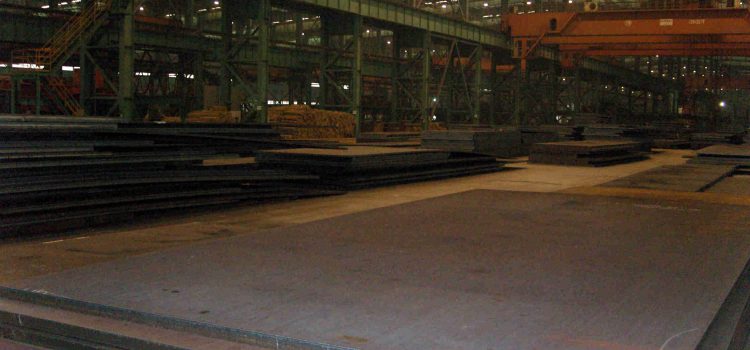
Gangsteel works with shipbuilding and offshore fabricators on ABS Grade FQ70 steel plate enquiries, production specification review and export supply requirements. For AB/FQ70 plate, we review the complete grade, thickness, manufacturing route and inspection scope before confirming an order. The ABS shipbuilding steel plate family provides related product context; availability and delivery are confirmed for the actual enquiry.
The numerical requirements below are based on the complete ABS Rules for Materials and Welding (Part 2), January 2023, Section 2-1-8, with the applicable general requirements. The current official edition listed in the ABS July 2026 Marine Vessel Rules is January 2026; the later edition’s numerical tables have not been independently verified here. Confirm the contractual edition before ordering. ABS Grade FQ70 uses a Charpy V-notch test temperature of -60 °C where the specified tests apply. These are laboratory test conditions, not approved minimum service temperatures.
Grade Designation
ABS Grade FQ70, also written ABS FQ70 or AB/FQ70, is covered by the extra-high-strength rules in Section 2-1-8, not the AH/DH/EH/FH tables in Section 2-1-3. The 70 category corresponds to a base minimum yield strength of 690 MPa. The FQ quality identifies the -60 °C Charpy test-temperature category. The complete designation, delivery route and any additional suffix must remain on the purchase order.
The Z35 wording in this product title describes optional through-thickness ductility, not another FQ70 tensile grade. It does not establish that every AB/FQ70 plate is Z35, that material is in stock, or that Gangsteel holds a current approval for a particular mill. Specify and document Z35 separately when required.
Key Advantages of FQ70 Steel Plate
- A complete AB/FQ70 designation links the enquiry to the appropriate ABS grade family rather than a generic strength description.
- ABS Grade FQ70 uses a Charpy V-notch test temperature of -60 °C where the specified tests apply. These are laboratory test conditions, not approved minimum service temperatures.
- Ladle-analysis requirements and specimen-specific mechanical acceptance provide a defined basis for mill-document review.
- Gangsteel reviews production and export requirements against the order; no unverified stock quantity, rolling size or lead time is implied.
Chemical Composition (Ladle Analysis, Limits %)
ABS January 2023, Section 2-1-8, Table 4A. Values are mass percentages, not typical heat results. Maxima, minima and ranges are labelled; these are ladle-analysis requirements, not product-analysis tolerances.
| Route | C | Mn | Si | P | S |
|---|---|---|---|---|---|
| TM | ≤0.14 | 1.0–1.70 | ≤0.60 | ≤0.020 | ≤0.010 |
| QT | ≤0.18 | ≤1.70 | ≤0.80 | ≤0.020 | ≤0.010 |
| Route | Al total | Nb | V | Ti | Ni | Cu | Cr | Mo | N |
|---|---|---|---|---|---|---|---|---|---|
| TM | ≥0.020 | ≤0.05 | ≤0.12 | ≤0.05 | ≤3.50 | ≤0.55 | ≤0.50 | ≤0.50 | ≤0.025 |
| QT | ≥0.018 | ≤0.06 | ≤0.12 | ≤0.05 | ≤3.50 | ≤0.50 | ≤2.00 | ≤0.70 | ≤0.015 |
For the listed routes, Ca is ≤0.005% and B is ≤0.005%. Total Al/N must be at least 2:1; when other nitrogen-binding elements are used, the Al minimum and Al/N ratio do not apply. For N/NR/CR and TM, total Nb + V + Ti is <0.26% and Mo + Cr is <0.65%; these combined limits do not apply to QT. Higher QT carbon or nitrogen may be agreed by ABS; TM/QT nickel is agreed at qualification. All Table 4A elements and any other intentionally added elements must be reported. Cu, Cr and Mo may be reported as <0.02% when not exceeding that amount. The oxygen-content rule is restricted to DQ/EQ91/98 and is not assigned to this grade. Plate does not receive the P/S relaxation for sections.
Chemistry is route-specific and must meet the approved material specification. A TM or QT column does not authorize every thickness for that route. N/NR/CR chemistry is listed only for AQ/DQ43, AQ/DQ47, EQ43 and EQ47 in Table 4A; it must not be extrapolated to other Q grades. No unverified product-analysis tolerance is assigned.
Mechanical Properties
| Property | Requirement |
|---|---|
| Yield strength ReH / Rp0.2 minimum, MPa | 690 |
| Tensile strength, MPa | 770–940 |
| Elongation minimum, % | 14 |
The elongation above uses the proportional gauge length 5.65√A, where A is specimen cross-sectional area, and transverse specimens. Alternative B specimens follow Table 5B instead. Where longitudinal tensile specimens are specially approved, minimum elongation is two percentage points higher. The ordinary plate tensile direction is transverse to final rolling; the rules include exceptions for leg, rack and chord plate. ReH is used, or Rp0.2 where ReH cannot be determined.
For thickness above 100 mm, ABS may consider a reduction in tensile properties only when accounted for during design. No reduced values are asserted here. For leg, rack and chord applications requiring strength through thickness, that reduction is not permitted and the R designation applies; this is separate from Z-quality ductility.
Confirm the contractual edition, plate identity and heat traceability, approved manufacturing route, specimen basis, impact tests and acceptance results on the mill certificate / inspection document. These requirement tables are not evidence of certificates currently held by Gangsteel, and no specific certificate type is promised here.
Charpy Impact Requirements
| Grade | Temperature, °C | Longitudinal, J min average | Transverse, J min average |
|---|---|---|---|
| AB/FQ70 | -60 | 69 | 46 |
Longitudinal or transverse Charpy specimens may be used as specified by the rules and order; the two energy values are not interchangeable. Sub-surface specimens are within 2 mm of the rolled surface. Above 40 mm, sampling is at t/4; above 100 mm, both t/4 and t/2 are required. Mid-thickness specimens achieve at least two-thirds of the Table 5A energy, or alternatively the full Table 5A energy at a test temperature 10 °C higher. Impact tests below 6 mm nominal thickness are normally not required.
Under Section 2-1-2/11.5, the average of three specimens must meet the required average; only one may be below it and none below 70% of it. Subsize requirements differ from full-size values. For ABS Grade FQ70, -60 °C is a laboratory test temperature, not a stand-alone minimum operating-temperature approval. Design temperature selection remains subject to the vessel/offshore rules, structural detail and approved design.
Delivery Condition and Weldability
Section 2-1-8 requires fully killed, fine-grain-treated steel with nitrogen-binding elements and controlled hydrogen practices. Vacuum degassing is mandatory for category 70 and for every grade above 50 mm thickness. Approved processes include normalized (N), normalized/control rolled (NR/CR), thermo-mechanically controlled routes (TM, with the approved cooling/tempering process), and quenched and tempered (QT), subject to the grade and thickness restrictions; Q in the designation alone is not proof that the plate was quenched and tempered.
Ceq is calculated from ladle analysis. For category 47 and above, CET may replace Ceq at the manufacturer’s discretion; Pcm may replace Ceq/CET for TM or QT steel only where carbon is no more than 0.12%. Formula selection is subject to manufacturer/purchaser agreement, and Table 4B gives route- and thickness-dependent maxima. Alternative limits require special agreement with ABS. No blanket Ceq or Pcm limit is assigned across routes here; the exact ordered route must be checked against Table 4B.
Welding requires review of actual heat chemistry, thickness, hydrogen control, restraint, heat input and the approved fabrication requirements. No universal preheat, welding procedure or post-weld treatment can be inferred from the grade name. Subsequent heating or forming must be assessed against the approved delivery condition; TMCP properties cannot be assumed to survive arbitrary heat treatment.
Z35 Through-Thickness Quality
ABS Grade FQ70 Z35 / AB/FQ70 with Z35 is an additional through-thickness quality requirement for details susceptible to lamellar tearing. It does not change the base in-plane strength grade or replace Charpy testing. Section 2-1-1/17 principally addresses plate and wide flat of at least 15 mm thickness, with thinner product also possible under its provisions. Order the requirement expressly; it is not automatic stock.
| Quality | Minimum average, % | Minimum individual, % |
|---|---|---|
| Z25 | 25 | 15 |
| Z35 | 35 | 25 |
Acceptance is based on at least three through-thickness tensile specimens; only one may be below the average requirement and none below the individual limit. The Z-quality rules require approved manufacture and ladle-analysis sulfur no more than 0.008%, overriding a less stringent base-grade sulfur limit. Ultrasonic inspection is required under Section 2-1-1/17.11. The inspection document must record reduction of area, the grade with its Z25/Z35 notation and each plate’s ultrasonic result; where approved drawings require Z quality, certification is performed at the mill. No mill approval or completed test result is claimed by this article.
Available Dimensions
| Process | General maximum plate thickness, mm |
|---|---|
| N | 250 |
| NR / CR | 150 |
| TM | 150 |
| QT | 250 |
These general ceilings do not authorize every route for AB/FQ70. Table 4A restricts N/NR/CR grade coverage, and Table 4B lists TM category 63 only through 100 mm and TM category 70 only through 50 mm; do not extend these routes using the general 150 mm ceiling. Thicknesses above the Table 3 limits require special ABS consideration. Above 100 mm, the mechanical-property qualifications described earlier remain applicable. Actual mill approval and the agreed manufacturing specification control the proposed order.
No commercial plate width or length range is established by the cited grade tables. Send thickness × width × length, quantity, dimensional tolerances and any cutting drawings for agreement. Confirm actual dimensions, approved production scope, inspection and delivery before purchase; no stock sizes or inventory quantities are asserted.
Main Applications
- Highly loaded welded marine and offshore structural plate components where the approved design expressly specifies AB/FQ70.
- Leg, rack or chord fabrication only with the applicable R designation, through-thickness strength requirements and approved fabrication plan.
- Other extra-high-strength structural details subject to engineering review of toughness, fatigue, thickness and welding constraints.
The suitability of ABS Grade FQ70 depends on the approved structural detail and fabrication route, not just yield strength. It is not automatic pressure-vessel approval, a corrosion-resistance guarantee or permission to use the plate at its Charpy test temperature.
Equivalent Grades of FQ70
| ABS grade | Base yield min, MPa | Base tensile, MPa | Charpy test-temperature category, °C |
|---|---|---|---|
| AQ70 | 690 | 770–940 | 0 |
| DQ70 | 690 | 770–940 | -20 |
| EQ70 | 690 | 770–940 | -40 |
| FQ70 | 690 | 770–940 | -60 |
The shared strength category does not remove differences in chemistry, toughness, test scope, delivery route or optional Z quality. No automatic cross-society or EN/ASTM equivalent is asserted for ABS Grade FQ70. ABS, BV, CCS, DNV, GL, KR and LR specifications must not be treated as drop-in substitutes. Any replacement requires a complete comparison and designer, purchaser and classification acceptance as applicable.
Related Products
- ABS shipbuilding steel plate — family page
- ABS Grade AQ70 steel plate
- ABS Grade DQ70 steel plate
- ABS Grade EQ70 steel plate
- ABS Grade FQ43 steel plate
- ABS Grade FQ47 steel plate
- ABS Grade FQ51 steel plate
Frequently Asked Questions (FAQ)
What is ABS Grade FQ70 (AB/FQ70) steel plate?
ABS Grade FQ70, also written AB/FQ70, is an ABS extra-high-strength structural plate grade. Use the full designation and contractual rules edition; the numerical tables here are explicitly based on January 2023, not a verified January 2026 table transcription.
What impact requirement applies to ABS Grade FQ70?
ABS Grade FQ70 uses a Charpy V-notch test temperature of -60 °C where the specified tests apply. These are laboratory test conditions, not approved minimum service temperatures. Use the thickness, specimen direction, energy and exemption details shown above, rather than treating a single temperature as an operating limit.
Does ABS Grade FQ70 automatically include Z35?
No. ABS Grade FQ70 identifies the base grade. Z35 must be separately specified, produced and tested to the applicable through-thickness rules and documented for the actual plate; a product-title reference is not proof of supply.
Which delivery condition should be ordered for ABS Grade FQ70?
The ABS Grade FQ70 delivery route must be within the mill’s approved grade and thickness scope and the applicable ABS tables. Agree the route before ordering; the designation alone does not guarantee as-rolled, normalized, TMCP or QT material.
Can another steel replace ABS Grade FQ70?
Not on strength alone. For ABS Grade FQ70, compare chemistry, thickness scope, impact acceptance, delivery condition and inspection requirements, and obtain the required project and classification approval before any substitution.
What should an enquiry for ABS Grade FQ70 include?
Provide ABS Grade FQ70 / AB/FQ70, the rules edition, dimensions, quantity, approved delivery route, Charpy requirements, any Z35 or ultrasonic requirements, inspection documentation and processing drawings. Gangsteel can review these requirements before confirming production availability and export terms.
For ABS Grade FQ70 steel plate enquiries, contact Gangsteel with the specification, plate dimensions, quantity and inspection requirements.